


When your EV charges slower than usual or doesn’t charge at all, it’s easy to worry something is broken. But often, it’s just the weather. Cold or hot, temperature plays a big role in how fast — or if — your electric vehicle charges.
Yes, temperature directly affects electric car charging. Batteries don’t like being too cold or too hot. Cold weather slows down chemical reactions inside the battery, making it charge slower and hold less energy. Hot weather can also reduce charging speed as the battery protects itself from damage.
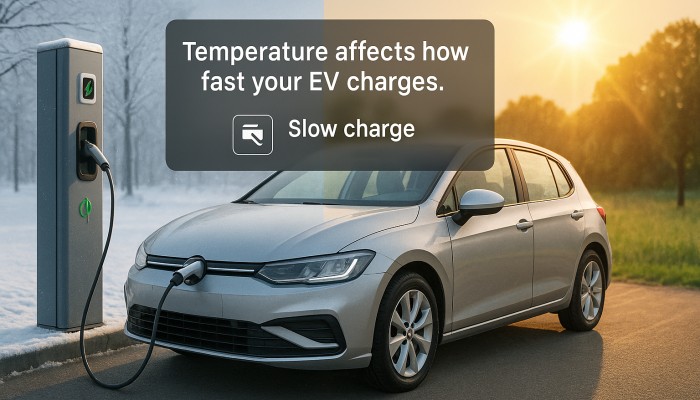
On a hot summer day or a freezing morning, your EV battery might act differently. It’s not malfunctioning. It’s adapting. That’s why understanding how temperature works with EV charging helps you get more out of your electric vehicle.
Why is EV not charging in cold weather?
You plug in your EV, but nothing happens. Or it charges at a crawl. Why?
In cold weather, your EV battery’s internal chemical reactions slow down. This makes it harder for the battery to accept a charge, especially if it’s below freezing.
When the battery is too cold, your car may delay charging until it warms up. Some EVs can preheat the battery 1 before charging. If yours doesn’t, charging may begin very slowly or not at all. Parking indoors or scheduling your charging right after driving can help because the battery will still be warm.
Can it be too hot to charge an electric car?
You might think only cold is the problem, but heat can be just as tricky.
Yes, high temperatures 2 can also affect EV charging. When the battery gets too hot, it may reduce charging speed or pause charging to avoid overheating.
Extreme heat causes the battery’s internal temperature to rise. The system might automatically slow down the charge rate to reduce heat buildup. If your car sits in the sun, try charging during cooler hours or find shaded spots. Good thermal systems 3 help, but they can’t do it all if it’s too hot outside.
What temperature is too cold to charge an electric car?
Where’s the line? How cold is “too cold” to charge?
Charging becomes unreliable below -10°C, and below -20°C, some EVs won’t charge unless the battery is warmed up.

Some EVs come with battery heaters 4 to handle this. Others need to warm up during driving or while plugged in. Using a scheduled departure time with preconditioning 5 is one way to make sure your EV is ready to charge even on the coldest days. Avoid leaving the battery at a low state of charge overnight in freezing conditions.
How much does temperature affect EV charging?
The difference in charging speed between a mild day and a cold one is often dramatic.
Temperature can reduce charging speed by 30% to over 70%, depending on how far it is from the battery’s ideal temperature range.
Estimated Charging Time by Temperature
| Ambient Temp (°C) | Charging Time (0–80%) | Notes |
| 25 | 30–40 min | Normal performance |
| 0 | 45–60 min | Slower charging |
| -10 | 60–90 min | Pre-conditioning needed |
| 40+ | 50–70 min | Battery may throttle speed |
This shows how colder or hotter conditions stretch charging times. The type of charger and the car’s system matter too, but temperature is always part of the equation.
How long does temperature affect electric car charging?
It’s not just the air temperature. It’s the battery’s temperature that counts.
Battery temperature affects charging speed until the battery warms up or cools down to its optimal range, which can take 15 to 60 minutes depending on conditions.
Charging a cold battery right after it has been sitting outside overnight won’t go fast. It might even pause. But if you charge after driving, or let the battery warm using the preconditioning feature, it will get into the right zone quicker. That’s when fast charging works best.
What’s the ideal EV battery temperature range?
Every battery has a “happy zone” — a range where it performs best.
The ideal temperature range for EV batteries 6 is between 20°C and 30°C. Charging and driving are most efficient within this window.
When the battery is within this range, you get full charging speed and better range. Below 10°C or above 35°C, the system starts adjusting how it works. You might see slower charging, less range, or both. Many EVs work in the background to stay in that target zone.

Are there any EV models that are more resistant to temperature fluctuations?
Some EVs are better at dealing with extremes than others.
Yes, some electric cars have better thermal systems that help them charge more reliably in cold and hot weather.
Thermal System Comparison of Popular EVs
| EV Model | Cold Weather | Hot Weather | Thermal System |
| Tesla Model 3 | Excellent | Excellent | Liquid-cooled |
| Nissan Leaf | Weak | Average | Air-cooled |
| Hyundai Ioniq 5 | Good | Good | Liquid-cooled |
| Chevy Bolt | Average | Average | Liquid-cooled |
EVs with liquid-cooled batteries tend to perform better year-round. Air-cooled systems cost less but can’t manage temperature as well. This makes a big difference if you live somewhere with harsh seasons.
How does the BMS adapt to different temperatures?
The Battery Management System (BMS) 7 is the battery’s protector.
The BMS controls heating, cooling, and charge rates to protect the battery when it’s too cold or too hot.
If the battery is cold, the BMS may delay fast charging until it warms up. If it’s hot, it may limit charging current to prevent damage. Some systems even stop charging altogether until conditions improve. It’s all about keeping the battery safe and lasting longer.
Conclusion
Temperature affects every part of EV charging. Cold makes it slow. Heat can make it stop. But your EV knows what to do — it adjusts through its BMS and thermal systems. If you know how your car reacts to temperature, you can charge smarter, avoid delays, and take better care of your EV battery.
READ ON:
Tesla in Cold Weather: Winter Charging Tips
How To Source Suitable EV Charging Cable?
EV Battery Longevity: How Long Can It Last?
- Learning about battery preheating can enhance your EV charging experience, especially in cold conditions.[↩]
- Understanding how high temperatures impact charging can help you optimize your EV’s performance and longevity.[↩]
- Explore the role of thermal systems in EVs to understand how they manage battery temperature and improve charging efficiency.[↩]
- Learn how battery heaters can enhance charging efficiency in cold weather, ensuring your EV remains functional.[↩]
- Discover how preconditioning can optimize your EV’s readiness for charging in freezing temperatures.[↩]
- Understanding the ideal temperature range for EV batteries can help optimize performance and longevity. Explore this link for detailed insights.[↩]
- Understanding the BMS’s role in temperature regulation can enhance battery safety and longevity, making it crucial for users and manufacturers alike.[↩]

